
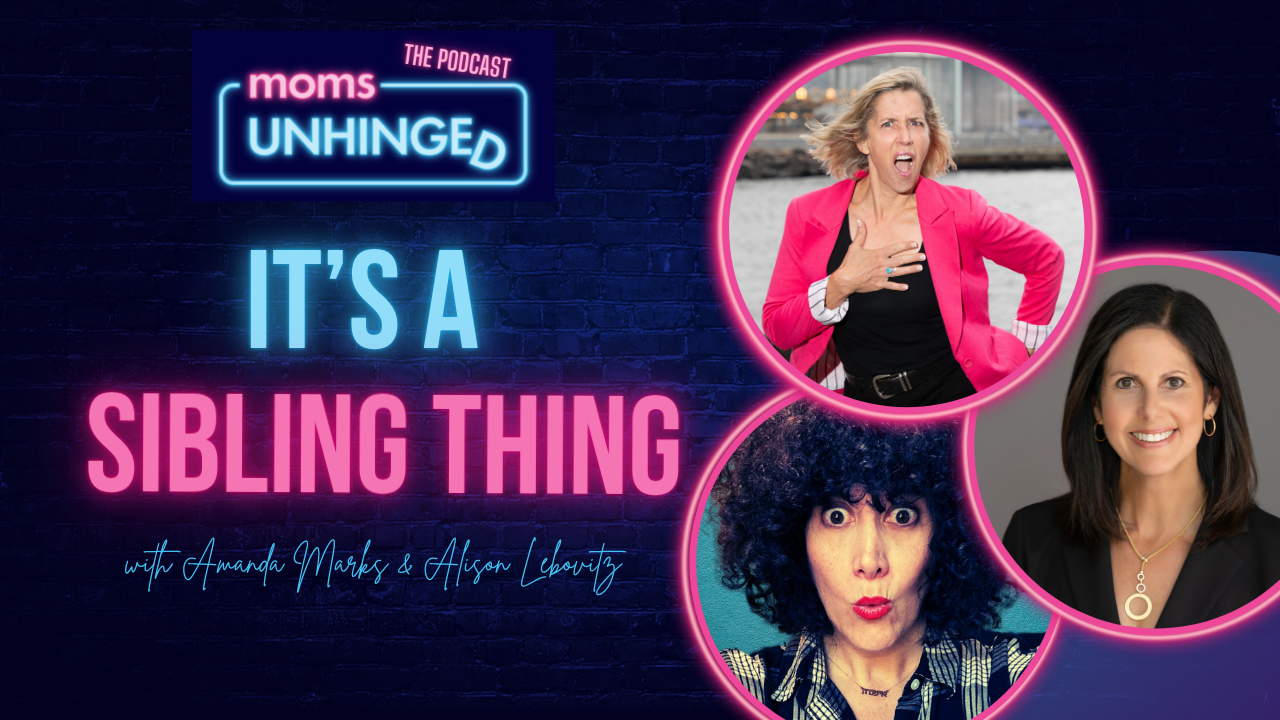
You can grow up, move out, have kids of your own… and somehow your big sister is still your big sister.
Amanda Marks and Alison Lebovitz know that well. The sisters behind the Sis & Tell podcast grew up seven years apart, with Amanda idolizing her teenage big sister and Alison, by her own admission, pretty much running the show.
Nine years into podcasting together, they have plenty of sibling stories to revisit. But now they get to see those dynamics from the other side, too. With six kids between them, they’re watching sibling roles, competition, and family dynamics play out in the next generation.
And it raises a question every parent with more than one kid eventually faces: How much are we supposed to manage our kids’ relationships with each other?
Do you break up the fight or let them figure it out? Do you insist the older kid include the younger one? Do you try to make everything fair? And if all else fails, do you make a spreadsheet assigning control of the TV remote?
In this episode, Amanda, Alison, and Andrea talk about:
- What birth order might have to do with family roles
- How their own places in the sibling lineup influenced the way they parent
- Why Alison’s three sons shared a bedroom—and still want to be together as adults
- How Amanda used a spreadsheet to settle her twins’ arguments
- When parents should intervene in sibling squabbles and when to stay out of it
Because maybe the goal isn’t to raise siblings who never fight. That’s probably a losing battle anyway.
Maybe the goal is to help them build a relationship that can survive the fights, the competition, the stolen remote, the coveted front seat, and all the other ridiculous things that seem incredibly important when you’re growing up.
Eventually, they won’t need you to referee anymore. And if you’re lucky, they’ll still choose each other when they don’t have to.
Interested in sponsoring Moms Unhinged?
Our podcast and live shows reach thousands of women who trust what we recommend — and support the brands that support this community. From host-read podcast placements to in-person show sponsorships, we offer flexible ways to partner.
Prefer reading to laughing out loud? Peek at the transcript.
Keeping the peace between twins
Amanda Marks: Oscar and Ruby, the twins used to everything. And they’ve spent so much time with each other, I joke that I need to get them a couples therapist.
Andrea Marie: We are Moms Unhinged, a nationally touring standup comedy show. Join us in our podcast as we explore everything from motherhood, midlife, crisis, marriage, divorce, online dating, menopause, and other things that irritate us.
Hello, everyone, and welcome to Moms Unhinged, the podcast. I’m your host, Andrea Marie, and I am joined today by with Amanda Marx and Allison Lebovitz. They are podcasters, from Sis and Tell. And also Amanda is one of our Moms Unhinged comedians, but you guys have had, how long have you had the podcast now? It’s been a long time.
Amanda Marks: Since May 2017. We are in our 11th season.
Andrea Marie: 9 years, that is incredible.
Alison Lebovitz: And this is the time of year, Andrea, I always say, “Are we done yet? Is that it? Am I done? I off the hook? Is my contract up, Amanda?”
Amanda Marks: We do. We have a contract.
Andrea Marie: I know you probably didn’t start, you probably didn’t, you probably didn’t launch the podcast and say, “Hey, let’s do this for the next nine years.”
Amanda Marks: Oh no, we said 18 years. I said I made her commit, and I’m the younger sister. She’s my, Allison’s my oldest sister by seven years, and, we talk all the time, but we didn’t… You know, when she was 16, I was nine. So we weren’t growing up in like, the same way. She was a teenager and driving away from the house, and I was driving…
Alison Lebovitz: Amanda was little and driving me crazy.
How a phone call became a 9-year podcast
Andrea Marie: Yeah. Yeah, I’m sure it’s such a different experience with that big age gap. So you started the podcast. What was the, impetus for starting the podcast? How did that come about?
Alison Lebovitz: So we were having just a normal sister conversation. I was standing in my kitchen, and I don’t even know what we were talking about, but I said, “Oh my gosh, this conversation is so funny, it could be a podcast.” And Amanda said, “Okay.” I said, “Okay, what?” She goes, “Let’s make it a podcast.” I go, “What are you talking about?”
She goes, ” I think we should just do a podcast. Let’s just do it.” That was, and I’m not exaggerating, Andrea, that was a Tuesday. By Friday, we had our first podcast episode on air. And our big mantra is, “Don’t let perfect be the enemy of great or even okay.” And so every week, as you can imagine, right? I’m sure you feel this too,
Amanda Marks: We put out the most mediocre podcast we can, yeah.
Alison Lebovitz: Right? We try to be less mediocre every week.
week and So far we think it’s working. Just a little bit better, yeah.
Andrea Marie: yeah.
Alison Lebovitz: And that was it. We had a name, we had a website, we had, at the time, these very sort of remedial Time Life operator headsets that we We bought a program for 30 bucks that we used while talking over Skype.
It was very, very elementary and very low-hanging fruit. Like, it didn’t cost us a lot to do something that eventually turned into, not just a weekly habit, but really a sacred conversation for the two of us. Now the funny thing is, is if we’re talking and we start going into a story that could be good fodder for the podcast, I’m like, “Gotta go. Stop talking. Hang up. See you soon.”
Amanda Marks: We put it in the Notes app. That’s about as organized as we get also is an outline we separately keep of things to talk about
Andrea Marie: Yeah, yeah. That’s awesome. Well, that’s so great. I love that, and we will have the link to your podcast in our show notes of course.
Growing up seven years apart
Andrea Marie: But like that’s so interesting growing up with such a big age gap, you know, we were talking just a little bit before, you may not have had like sibling rivalry, but like different, a different sibling dynamic.
Like what was that like?
Amanda Marks: So I…
Alison Lebovitz: I’ll let Amanda answer ’cause I don’t really remember her back then, so.
Amanda Marks: know, forgettable.
Andrea Marie: Oh, yeah, I do have a sister.
Alison Lebovitz: All right.
And we have a brother too. We probably mention that.
Amanda Marks: I know.
Alison Lebovitz: There’s a brother in the middle, right.
Amanda Marks: Right? Poor guy, the middle child. No, he’s actually the favorite of all the siblings, including… we adore him. It’s gross. It’s gross. We love him. We love our brother. But it’s like growing up, I would say it was more sibling revelry than sibling rivalry for me.
Andrea Marie: Hmm.
Amanda Marks: I idolized Allison. I just wanted to be around her, right? She was like a celebrity to me, and I was no shrinking violet. You know, I was very precocious, very outgoing. I would talk to anyone and say anything. I was pretty unpredictable. And I mean, just growing up, she just seemed like, It felt like an episodic to me in some afterschool teen show, right?
Like, she had all of her best friends, and she was driving around, and she went to a really fun school. And I just, you know, I just really, I wanted to just be like Allison. I remember one time the air conditioning broke on the top floor where her bedroom was, and she was having her best friend Elise spend the night.
And my mom came to me and said, and I must have been, like, eight. And my mom came to me and said, “Are you okay if they sleep in your room?” And immediately I was like, “Yes, that would be amazing.”
And my mom was like, “Oh my God, Amanda’s so selfless. She’s giving up her room.” And then I was like, you know, arranging my Cabbage Patch Kids in a way and I was like, “Oh my God, I’m having a sleepover with Allison and her best friend.” And then when, and then it was Allison and her friend moved in and I had to move out, and I was like, “What’s happening?”
Andrea Marie: Wait, this is not what I agreed to. I agreed to.
Amanda Marks: They stuck me on the couch. At least I got air conditioning, but.
Alison Lebovitz: Yeah. There are stories and stories like that. I, you know, when I look back at the reel of my life in growing up together, I’m not proud of all of those moments. I own them. I take responsibility for them, and the way that I’m apologizing for them and saying, “How can I make it up to you?” is the podcast we do together.
And every year I’m like, “How much longer?” And she keeps extending my contract of trying to pay back the ill will that she felt as a big sister. I don’t, you know… I think it’s… I was probably like, “18 years might be good,” right?
I’m gonna be in the retirement home by the time we finish. But I, yeah, the dynamics, you know, and I look at families now and that age gap, it either breeds one of two things.
It breeds a disconnect between the siblings where they sort of grew up or literally grew up having different childhoods and as we say, our kids, right? No matter how many kids you have, your kids have different parents because you’re a different person when you parent them. So I get that, too.
But also, I see some that, you know, have a seven-year gap, a nine-year gap, a 12-year gap, and the oldest is very maternal to the youngest, and I consider myself a fairly maternal person.
I mean, I have three boys. I think they consider me fairly maternal, but I really wasn’t that way. I don’t remember being likr the, you know… Sorry, Amanda. This is part of… Thank you for having this therapy session for us, Andrea. Iy was not, it wasn’t… I cared… Yeah, maybe I didn’t care for you that much.
I mean, I did, but I don’t think you can, I don’t think you can really do justice to what a big personality she was. I mean, when she says I was no shrinking violet, we used to, the whole community. We grew up in Birmingham, Alabama. Everybody that knew us knew, quote, “Amanda stories.” She was crazy. She was boy crazy.
She had no shy bone in fearless her body. She would not only talk to anybody, she would say anything, and for the people that she was unfiltered with, they actually appreciated it because she would say the things that most people only thought, and she did it in a beautiful, quirky, you know, childlike way, ’cause she was a child.
But we couldn’t compete with that. When you talk about rivalry, my brother and I, as much as we might have liked the spotlight in our own ways, we literally could not compete with Amanda. She was the star of the Goldstein show, let’s be clear.
Amanda Marks: Oh, that’s sweet.
Andrea Marie: Yeah.
Alison Lebovitz: Oh, that’s just truth.
Andrea Marie: Yeah, and now she’s on stage all the time, so that makes sense.
Amanda Marks: Allison’s also on stage also.
Andrea Marie: Oh. Yeah.
Amanda Marks: We are all, like Allison, but Allison also has, a lot of accolades around the career she’s created and was always a leader. And so I think we were, we all had big personalities. And like my kids, I say you could hear us before you could see us.
Like, I think my whole family is pretty gregarious, although we call my brother more of like the Bob Newhart as far as his comedy goes.
Andrea’s big-sister moment
Andrea Marie: Kinda dry. Yeah kinda, yeah, understated. That’s so funny. That’s so funny. Well, it’s so interesting the whole, like, I think for sure it’s easier for the big sibling to kind of, you know, there’s like you’re just doing different stuff. You’re older. I have a funny story from my sister and I where I was going around, I had one of those old tape recorders, and I was interviewing, you know, kind of, I was pretending I was an interviewer, journalist type of thing, and I would hit record.
And be like, “Okay, now I’m gonna interview all the important people in the family.” So I talked to my mom, talked to my dad, and you can hear my sister in the background going, “I’m important.”
Amanda Marks: Aw.
Andrea Marie: ” And now I’m gonna interview, and now I’m gonna interview the toilet.” So I flushed the You know, like I interviewed the toilet before I interviewed my sister.
So you know, it’s just, it is definitely there’s a trickle-down, like it’s easier for the bigger, bigger sibling to dominate, I think. But you know, I mean, I think the younger siblings have to find a way to get that attention, so that’s interesting.
Amanda Marks: Well, my brother was only two years younger than Allison, so closer in age, but I think we grew up hanging out with each other a lot more than Stuart did with Allison.
And it was
Alison Lebovitz: A shared trauma of
me of me pushing them away. Yes. “Does she talk to you?” “No.” “She doesn’t talk to me either. Let’s bond.” Trauma bond. Woo.
Amanda Marks: But what we bonded over was my dad bought a home video camera in, in like the mid-’80s or the early ’80s. He was always an early adapter of technology, and he got this ginormous home video camera. And my brother was obsessed with it, but he did not wanna be in front of the camera.
He wanted to create content. So even if he had his friends over, he would still let me be a part of whatever the content was because it was just more characters to be in whatever he was creating. And we did. He loved Saturday Night Live and it, like sketches and everything. So every, and we would do like commercial parodies and a lot of fake newscasts, and he would just tell me what to say.
And I would just do it, you know? So it was a great, it was a great combo.
Raising three brothers under one roof
Andrea Marie: Yeah. That’s awesome. So what do you notice about your own kids? Are they have, do they have their own rivalries? Allison, you were just asking your son just off-camera a little bit before we, but like how do you think their rivalries play out?
Alison Lebovitz: Yeah, it’s funny, I mean, our memories are short when it comes to anything of, you know, that creates dissonance, I think. We remember the, the better and the good versus the, the tiresome or the challenging. And our three boys, so they’re all basically two years apart. The older two are two years, and the bottom two are 21 months.
And so the oldest now is 26, then 24, 22, and growing up they all shared a room. So it was a forced love. Three, three boys and the tiniest bathroom in the house, and, it didn’t happen intentionally, like we got, you know, on board saying, “We’re gonna have them share a room and so they’ll be close siblings.”
It was just really a matter of how they were spread out and where, how the layout of our house was, so they all ended up together. But there was only one time where Arthur had asked about having his own room, the oldest, when he was about 12, and other than that, nobody ever asked. And even today when they come home, they’re all…
You know, we’re empty nesters, but when they come home, they all wanna share a room. So I had to, yeah, Arthur, the 26-year-old, happens to be home this week, and I says really quickly, “Do you have a rivalry?” And without hesitating, he said, “Oh, yeah.” But I like the way he framed it. He said, “Not long term.
We’re not rivals long term. It’s an in-the-moment.” Like, our fit, meaning, you know, what they’re putting on to wear one day or the next. Sports, the older two in tennis, they had to compete against each other when they were in sixth and eighth grade in middle school together, and on the ladder of tennis they were constantly like 11 and 12, 12 and 13, 13 and 11.
You know, like going back and forth. But they kept it healthy. I think they, they understand each other’s strengths, and they understand their own strengths and maybe challenges or weaknesses, and they celebrate each other. So it’s, I think at the very least, a healthy rivalry they have with each other, and they have a great competitive spirit in general.
But also they don’t miss an opportunity to compete, and in equal measure they don’t miss an opportunity to celebrate each other in really sweet ways.
Andrea Marie: Hmm. Mm-hmm. That’s great.
Amanda Marks: Yeah, I was gonna say that I do think that Allison’s room layout for her boys was inspired by The Brady Bunch because she does.
Andrea Marie: Did they ever tape? They never had the tape down the, you know.
Alison Lebovitz: Almost. Almost. Abe, our middle one, is the neatest. He still is the neatest to this day, and there was a point, he and his oldest brother, the way… It looks like a dorm room. I mean, imagine each bed, and then I let them decorate their walls according to their own tastes and interests, which is hysterical.
But the oldest and the middle share this old chest, so they have half their, literally half their stuff in the drawers and half their stuff on top. And Abe would make these piles, and if he had, if I’d given him blue tape to do it, he would’ve taped his whole side of the room so nobody could go down there.
So he was definitely the Bobby Brady of the family. He would’ve taped it off. But the good news is, nobody… You know, like when I was younger, I would lock myself in my room for hours or days if I didn’t wanna talk to anybody. None of my kids ever did that because they’d be stuck with the other two. So it was actually a good way to keep them socializing with the rest of the family, too.
Andrea Marie: Yeah. Yeah. That’s a benefit of growing up where you just don’t have anywhere to go to.
Alison Lebovitz: Right.
Welcome to the kitchen. We have food. Come on.
When siblings compete for Mom’s attention
Andrea Marie: And how about your kids, Amanda? Do you notice some rivalry there, or if you had to break up fights or anything like?
Amanda Marks: So we have a little bit of a different dynamic. We also have three kids, and our oldest is now 20, and he’s three years older than, we have boy, girl twins. So I have to say, I was relieved when I found out that when I was having twins that I was having one of each because I was really worried about comparisons and just natural sib- sibling rivalry just growing up with someone the same sex, and especially if they were girls.
But that being said, they are very competitive. My daughter’s very competitive naturally. She’s a great athlete because of it. But I feel like all three of them are competing with who can have a conversation with me. It feels like an ongoing, like everyone’s always like, “Can we go on a walk so we can talk?”
Like, and I feel lucky that my kids wanna talk and share with me. But there’s definitely a little bit of a rivalry going on between the twins just for, like, constant attention. They are an but with the kids in sports, , I’d say once in a while there’s some rivalry with, in playing basketball.
Like, but it’s like a healthy competitiveness.
Andrea Marie: Yeah, that’s good. I know, it’s hard to balance as a, a parent on, like, when to get involved or when to stay out of it and let them sort it out. I remember- there was a time where my oldest son once just was so irritated. ‘ Cause my youngest son, it’s really a lot about the attention, right?
It’s like we just are like, you know, they either want attention from us or maybe from each other that they’re not getting. And, you know, my youngest son just really wanted to be around Devon as much as possible, my oldest, and was like, you know, it was when he was, like, eight or nine and I would…
All he wanted to do was watch him and, you know, my oldest son and his friend play a board game. That’s all he wanted to do. And so like, we… I was like, “Okay, you know, there shouldn’t be a problem with just watching them play a board game.” And I, you know, it wasn’t every time, but this one time in particular I remember, and I was like, “Come on, just let him watch.
He’s not gonna say anything.” And I think Henry made one peep, and it was like, “That’s it.” You know, it was like, “Why?” And then just like all hell broke loose. You know, it was like, just craziness. And like, he’s like, “I just said one thing,” and you know? It’s like it is hard to know, like, when to step in and when to, and when to just let them work it out, you know.
Does birth order shape you?
Alison Lebovitz: Yeah, and I don’t like to stereotype, but I do believe there is something about birth order, and that it presents, and there’s… Yeah, and I’ve been in situations even, you know, I was part of a, a national leadership group and, one of our speakers came in one time. We had a group of probably 80 in this one, session, and they just off the cuff said, “How many of you, by the way, are firstborns?”
And probably 60%, 75% of us, the majority raised our hands, and we all looked around and no one had asked us that before. And it was remarkable to look around of what that position, right? That, that station in life that you’re literally born into. Well, you know, like I was born to lead, but I, you know, I, I think given that position, I see it with my own kids.
But also, it was interesting when the oldest left, and graduated high school, the middle took on that role. So I think it’s also a matter of, you know, when leadership is thrust upon you take on sort of this mantle of responsibility and trust and encouragement, and I really saw the dynamics of their relationship change.
The bottom two, I talk about them in tops and bottoms all the time.
Andrea Marie: Yeah.
Alison Lebovitz: The top two, the bottom two, I can’t keep ’em straight. I start calling him Stuart, which is our brother’s name, as I said, when I get frustrated.
Amanda Marks: You can’t say the big one, the big one ’cause the littlest one is the biggest one, yeah.
Alison Lebovitz: Our youngest, our youngest who’s 22 is 6’5″ and he towers over everybody in our family. And of course, talk about rivalry, the first time he figured out how to dunk the basketball, that was it, and to this day he’ll just keep sending videos of him dunking and nobody is happy about it. I’m fine with it.
I never aspired to dunk, but I think that is… I think they have a place. Go ahead, Manda.
Amanda Marks: I was gonna say, I think birth order also affects how you parent, right? Like, I think Mommy, our mom, who is the oldest of her siblings, she was very empathetic towards Allison having independence as a teenager and alone time, and understood the need for her to like, live her life as a teenager without siblings there.
Andrea Marie: Right, right.
Alison Lebovitz: That’s funny. And you as the youngest, you’re constantly like, “Include them.”
Amanda Marks: I know, yeah. So our poor, like our poor oldest child, like my husband and I were both the youngest children, so we were like, “You’re gonna be the best big brother.”
Andrea Marie: Uh huh.
Amanda Marks: You be nice to them. And he is. He’s like, “If anything, we’re like, ‘You be nice…'” ‘Cause they’re, the twins are like now an entity. They’re kind of scary, right?
Andrea Marie: Yeah.
Amanda Marks: Like, “You be nice to your big brother.”
Andrea Marie: Yeah. That’s so interesting. I never thought about how birth order affects how you parent well. Where you have that, you know, empathy, that connection, that like remembering how you felt, you know, when you were that age. That’s so, that’s so interesting.
When should parents step into sibling fights
Andrea Marie: Yeah. So like yeah, so have you had to break up any big fights or anything like that between, amongst your kids? And how have you handled that?
Alison Lebovitz: It’s funny, I ask, people ask me all the time because we have three boys and because they lived together in the same room, so they fought all the time, didn’t they? And I know they, they argued, but they asked me, they really wanna know if Oh, wow they fist fought, and they didn’t, as far as I knew. Maybe I was naive, but I asked them.
We were together with two of them and I said, “Did y’all fight?” And they said, ” Yeah, we fought,” you know, growing up. I said, “No, did you fight? Like, with like, hit each other?” And they looked at me like I was crazy. They go, “No, we’ve never. No, we’ve never been in a fight,” right? And also you have to, I mean, we’re raising nice Jewish boys who, I mean, nobody’s ever, right?
Like, it’s like, “No, don’t ever use your fists,” right? “Use your words. We can…”
You know? So, anyway, they’ve pretty much navigated that themselves. We would sometimes, it’s like, to your point, Andrea, when do you intervene and when do you say, “You guys work it out.” You know, “Sit on the couch and hug until you can figure this out,” or…
My husband was notorious, and anybody who knows us knows, when the boys misbehaved and if they were fighting and could not reconcile it, he made them do pushups. So I used to say, “Our boys are not well-behaved, but they’re very strong. They’ve got huge muscles, but they’ve got no temperament.”
But they, you know, I think they also learned that there are consequences to your behavior and your words, but I think there is, you know, it’s hard to remember too. Again, I’ve probably just sort of glossed over all of those, those challenging parts because they also were kids at the time. Nothing that was ever detrimental to their relationship.
They’re so close now. Like they wanna be together. If two of them are together and the third one’s not, you know, the oldest is here right now working and, and the other two are in New York together, and he’s freaking out. I mean, he’s literally, he had to FaceTime him last night. He goes, and he looks at me and he’s like, “I really, yeah, I really enjoy being home, but I really wanna be there.
I don’t know what to do,” right? So they miss being together and they have, we call it the brother code, that they have to, you know, they abide by. They have information they share with each other, stories that they don’t share with us or others. They defend each other, and in private if they have an issue, they can talk about it.
So they’ve navigated those waters, I think, pretty, pretty beautifully.
Why siblings may be your longest relationship
Alison Lebovitz: And, you know, you want your kids… our mom always says, “Your siblings will be the longest relationship you ever have,” right? Like, your parents will pass away, you know, in an ideal world before you, and your kids will outlive you.
But your siblings are the ones that you’re born into this world with, and you almost leave the world together. And so you wanna figure out a way to really create a sacred bond with each other. I feel like I’m getting that second chance. I know I joke with Amanda that I’m sort of, you know, enslaved to this podcast as a way to work off my bad years.
But, it is really a gift. It’s such a gift to be able to have this cadence of our relationship and conversation, and to share stories, but also best friendship that has evolved from a true sense that we love each other and we like each other and we respect each other, and it’s not forced. Our parents did their work. Right?
There’s only so much you can do. You either love each other and like each other and get along or not. At some stage, you know, they’re all cooked. We’re cooked. So, you know. I love you, Amanda. I love you.
Amanda Marks: I love you. You’re okay. You’re okay.
The spreadsheet that settled sibling arguments
Amanda Marks: Well, so yeah, like, Oscar and Ruby, the twins, used to everything. And they’ve spent so much time with each other, I joke that I need to get them a couples therapist because they’re… I mean, they’ve But when they were younger, like seven or eight, like they…
I read somewhere, like take away the thing that they always argue about, right? Like don’t let them have this argument, and the biggest thing was the TV remote and who got to watch when. So I took away that argument by creating a spreadsheet of who had the remote each day, and from there they started using that for everything on their own.
They would, you know, who got to sit, who got to sit up front? Who was shotgun? Do you have the remote control today? Okay, then you get to make that decision. It’s really, it’s solved. Now that, you know, they’re driving, they’re like, “Who gets the…” You know, they, “Who gets the car?”
Which is really my car. Like, who gets to drive? And it’s, “Oh, is it today your day on the remote?” You know? Yeah but poor Murray was not the, my oldest, was not even on the remote control schedule.
Andrea Marie: it’s not even on the spreadsheet. You did not make the spreadsheet.
Amanda Marks: “Why am I not on the spreadsheet?”
Alison Lebovitz: Such flipped household. I’m laughing because growing up, I really ran a dictatorship, didn’t I? I mean, I was always up front by the window as long as I was in the house. If the phone… Amanda tells the stories. When you were on the phone, I’d go, “I need to use the phone. Get off.”
Right? There were no cell phones back then.
And she would, right? “And get me some water while you’re at it.”
Amanda Marks: Well, Murray’s like, if you’re gonna compare your kids to animals like, or different dog breeds, Murray’s a German Shepherd, right? So we didn’t need to put him on the schedule, ’cause he would just walk in and they’d be like, “Here you go.”
When they were little, they especially just like, adored him, and he is a gentle giant, much like Levi, where he was just always massive for his age. So, and he has a whole entire, like, playroom floor to himself. Even though it is the playroom, they don’t go up there. It’s like it’s his space.
He has, you know, control over it. But yeah.
Andrea Marie: Above the spreadsheet. He’s like, yeah.
Amanda Marks: He’s above the spreadsheet, ’cause he would come in and just take the remote, and they’re just like, “Okay.” Well, now then they got a little older and they’re like, “Uh-uh, today’s not your day.” And that’s when he was like, “Do I get a day?” I’m like, “Fridays and Saturdays and Sundays are totally open.
It’s the days of the week. You’re good.
Alison Lebovitz: By the way, and we see it’s, you know, back to birth order, my mom, who has two siblings, and a similar spread, her sister’s five years younger than she is, and her brother’s nine years younger. I’m almost, you know, I’m only 16 years younger than her baby brother, so the spread’s not even that big. So I grew up, twice in my life I lived with him, so there’s a, there’s all this overlap, and his daughter is just a few years older than our oldest.
So all the generations sort of blended together, but there is distinction in terms of birth order when you get our whole, like these.
Amanda Marks: Oh, everyone.
Alison Lebovitz: Together, and my mom is still, my mom is still in charge, and she isn’t… And the siblings, even if they heard this, they would agree, she is in charge of her siblings, and when she says something, agw makes sure that they, are in alignment and that they are together, but I wouldn’t say they have to have consensus.
Andrea Marie: Yeah, her vote gets, carries more weight.
Alison Lebovitz: Yeah.
fine with that, I think just ’cause they grew up. And she also tells me, since her parents have passed, she feels like she has to be the parent of the family that she quite literally and figuratively takes on the role as, as both parents now because she is the oldest of her family unit, of that, you know, that family unit.
So I see that too, and there’s a grace and I think a beauty in that too, but also, I mean, we know, we know mom’s in charge, and like everybody knows I’m in charge for the next generation.
Amanda Marks: I’m glad. Allison’s a great leader. I’m like, “She make all the decisions, great.” I don’t even research anything. I just, I’m like, “What did you do? Okay, I’m gonna do that. Great.” Saves me a lot of time. It’s very efficient having an older sister who’s smart, I have to say.
Alison Lebovitz: I want us to all be together, but I just want them to be together according to what I wanna do.
Amanda Marks: And these are the plans, yeah.
Well, I remember when, I was in college and, Allison and Stuart both got married within, like, three months of each other to their spouses, and everyone was home, and I was probably, like, 19, and we were all in the living room, and my brother is like, “Hey, Amanda, go get me some orange juice.” And I was like, ” Okay.”
So I got up from my comfortable seat, I started walking to the kitchen, and my sister-in-law goes, “What? What are you doing?” And I said, “I’m getting him orange juice.” She goes, “Why?” And I was… ‘Cause she’s the oldest of her… And I go, “Because he asked me to,” and I thought I was just doing a nice thing.
Andrea Marie: if that was an ask either. I don’t know if that I mean.
Amanda Marks: It wasn’t, no. Yeah. And my brother’s like, “Stop it. Stop talking.”
Andrea Marie: I know, right? You’re wrecking it. You’re wrecking
Amanda Marks: Not until that moment had I realized that I was also not just the youngest sibling, but the intern, right? Like, they would tell me what to do, and I would just gladly do it ’cause I thought I was doing them a favor, right?
I was like, “No, that’s just… Okay, I will stop what… get off the phone? Okay. Get you some orange juice? Got it. What else do you need? I can take meeting notes, too.”
Andrea Marie: Oh, it’s so funny. Oh my gosh. So this has been… time goes so quick. This has been so much fun. Thank you both, Allison and Amanda, for joining us on this. And I don’t know if it was you guys are all. You guys got along so well, and it sounds like your kids also get along fairly well. I don’t know if we can even call this episode sibling rivalry.
But it’s interesting to dive into the thought of it and kind of reflect back, and I love the idea of birth order coming into play. So, thank you so much both for your time and your insights, and we’ll make sure, yeah, we’ll make sure people follow your podcast too.
Alison Lebovitz: Thanks, Andrea.
Hey, Andrea, go get me some water before Yeah. we finish.
Andrea Marie: Hey, I’m first born.
No.
Amanda Marks: I’ll do it. You need some too, Andrea?
Andrea Marie: Yeah. Thank you both.
Thanks for listening and make sure you subscribe, share, and follow us on the socials to get more comedy clips.

Amanda Marks isn’t your typical comedian. She has a knack for turning the minuscule and mundane into monumentally funny material. Amanda performs stand-up comedy, produces and hosts comedy shows and co-hosts the award-winning Sis & Tell Podcast. She has opened for comedians Jessica Kirson and Judy Gold and was a finalist in the 2022 Ladies Room Comedy Festival at Broadway Comedy Club and featured on the Red Clay Comedy Festival 2024. She has also done voiceover work for Aqua Teen Hunger Force and Squidbillies. Follow her on Instagram @mallofamanda
Catch Amanda In An Upcoming Show
October 2026

Hosted by Emily Holden, featuring Amanda Marks with headliner Amy Brown
November 2026

Hosted by the very funny Amanda Marks, featuring Merit Kahn with headliner Lisa Lane.

Hosted by Amanda Marks, featuring Merit Kahn with headliner Lisa Lane

Ticket Details Coming Soon!